

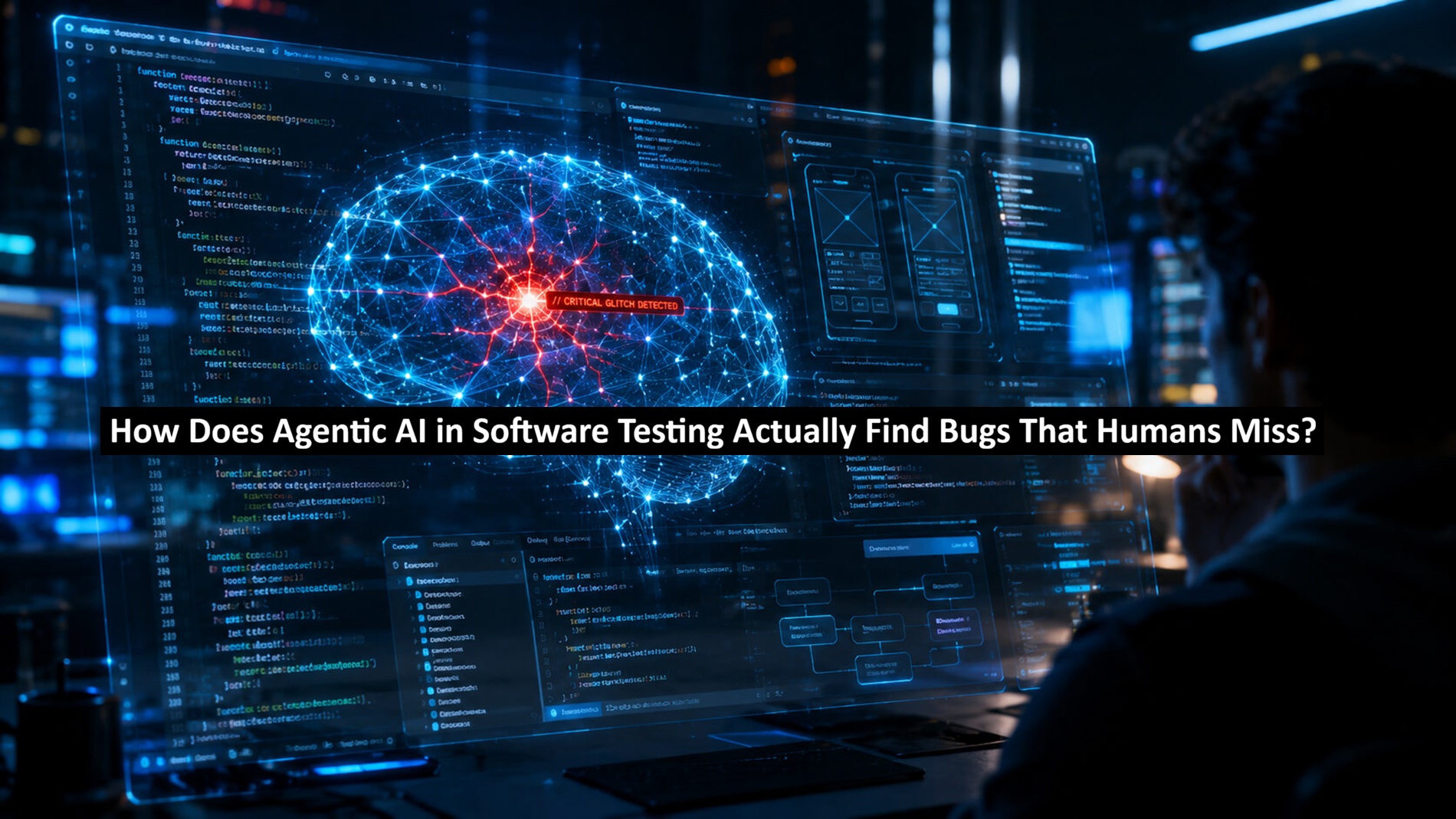
In today’s ever-changing world of developing software systems at a rapid rate with no end in sight, we’re not just facing simple coding mistakes anymore; we’re up against the “combinatorial explosion.”
Applications today are increasingly becoming complex architectures of microservices and APIs, resulting in exponential increases in the number of user journeys. A modern-day fin-tech or eCommerce application may have up to several billion state transitions, which is impossible to document and/or test by any human or team.
The method of automated testing that has been available to the software development world to this point is running into a brick wall. For years now, we have relied on “scripted” automation where the automation behaves like a tape recorder by repeating each of the same steps and checking off each of the same items. However, what happens when you have an essential defect ‘between’ checkboxes?
The advent of agentic AI represents a paradigm shift in software testing from being focused on verification to being focused on autonomous exploration of the software application. Using Large Language Models (LLMs) and advanced reasoning framework, AI agents can find “invisible” defects in the application that have existed for years without being found by human testers.
Read: How Phone Accessories Can Impact Heat and Performance
What is Agentic AI in Software Testing? (Evolution from Scripted QA)
In order to recognize the capabilities of agentic systems, we need to compare them to the traditional method of QA automation.
- Scripted Automation: This is based on a rigid “If-This-Then-That” structure. If the developer modifies the ID of a button, the initial automation script becomes unusable. It is therefore extremely fragile and requires the continual assistance of a human being to mantain.
- Agentic AI: The second approach features QA agents that can operate on their own and are able to achieve their goals. The agent is not told how to carry out specific tests (for example, “Click this ID”); rather, it receives a high-level goal (for example, “Attempt to complete a checkout process using an expired credit card and verify that you receive an appropriate error message”).
The term “agentic” represents the ability of an agentic system to perceive its environment, determine the next best action to take, and execute that action without a predefined script. The technology itself employs both computer vision technology and large language models (LLM) to interface with a software program in a manner that is similar to the interaction between a human and a computer, but with the processing capabilities of a computer.
The “Cognitive Gap”: Why Humans Miss Critical Bugs
Despite all the testing done in Quality Assurance, bugs can still make their way into production. The problem is Cognitive Gap.
The reason for this is that humans have a tendency to test through confirmation bias. This means that whenever a developer or tester tests an application, they do so with the intention of proving that the application works. They usually take the “Happy Path,” or the normal flow of usage by a user.
With agentic AI, there is no bias. There is no “preferred” way to use an application either. A human may not think to click on the “Back” button multiple times during a database write while in dark mode; however, an AI agent will do this type of thing. Agentic AI can find edge cases and bugs in ways that we cannot using human logic; therefore, it explores the non-linear state space of an application.
How Autonomous QA Agents “Think”: The 4-Step Discovery Loop
Agentic AI uses a continuous thinking loop to find bugs and does this by mimicking human-like intelligence on an enormous scale. The steps include:
- Semantic Perception: The agent uses computer images to locate the UI. It has the ability to find something you would like to “search” for by seeing a magnifying glass icon; regardless of coding or CSS Ids.
- Probabilistic Reasoning: The Agent looks at the display and asks, “Based on the product requirements, which of my current actions are potentially the most risky?”
- Action Based On A Goal: The Agent performs an action by taking some sort of action (for example, inserting a long series of letters or numbers into an input box) and collects information about how the system behaves in real time.
- Self-Correcting: The Agent does not simply stop working if it finds itself in an unexpected state. Instead, it records the state and analyzes why that path failed, then adapts to another strategy as a good exploratory tester would do.
3 Bug Types Agentic AI Finds (That Humans Don’t)
Agentic AI identifies three types of bugs that are incredibly difficult to find manually by working beyond the constraints of scripts.
1. State-Space Race Conditions
These bugs are triggered when individual actions occur when an event happens in a predetermined and global manner (for example: by having a user submit an application at exactly the same milliseconds that the internet was throttled on the local network). Agentic AI finds these types of bugs based on the amount and the fact that they are discovered quickly and through many different ways.
2. Semantic Logic Errors
A button may be functional, but what happens when a discount code generates a negative amount for the shopping cart? Thanks to Retrieval-Augmented Generation (RAG), Agentic AI can process documentation in a way that identifies the purpose of the application and identifies violations of business rules.
3. Visual & Accessibility Regressions
The human eye gets tired easily, and therefore, a user may not see that the “Buy Now” button has shifted three pixels or that the contrast ratio has changed. AI-based testing will compare pixels to find these regressions automatically across hundreds of device resolutions.
Eliminating the “Maintenance Tax” with Self-Healing Tests
For a software team, testing takes a considerable amount of time and effort to maintain quality assurance (QA) engineers. In fact, research shows that QA engineers spend 30% of their time correcting malfunctioning automated test scripts.
With self-healing test automation, Agentic AI makes it easy for testers to have confidence in the automated tests they create because the agent understands an element’s purpose rather than simply its technical location within the user interface (UI). Therefore, if the UI changes (for example, a “Login” button now appears green instead of blue or has been moved from one part of the screen to another), the agent still knows what that element is doing and continues with the testing process. Eliminating the maintenance tax allows software development teams to devote more resources to creating new applications instead of maintaining the ones that already exist.
The Future of the QA Engineer: Human + Agent
Will Agentic AI replace QA Engineers? No—it will evolve their roles into Agent Orchestrators.
The new model allows humans to create the strategy and assign the “risk profile” for an application. In essence, humans tell the AI what areas to focus on (such as “stress test the payment gateway”). More and more, hybrid synergies are being used in today’s software testing services — providing a level of coverage that manual testing would never be able to replicate. The automation takes away the tedious work of executing all the combinations of every possible variable and frees up testers to focus on high-value tasks such as security audits and user experience design.
Conclusion
Today’s software quality is one of the most important factors consumers take into account when deciding to make a purchase. Consumers will not put up with bugs, or “Ghosts in the Machine,” that are disrupting their ability to complete a task.
Agentic AI-driven testing solutions are the only way to achieve 90% + digital Test Coverage in this age of infinite digital complexity. Unlike humans who have limitations to what their minds can conceptualize as logic, Agentic AI can apply logic to find bugs that would otherwise be invisible to the eye.’
Author’s Bio:
Akshay Tyagi is a technical content specialist at NetClubbed. He bridges the gap between manual oversight and autonomous innovation, helping organizations integrate advanced software testing services to ensure flawless performance in complex AI environments.