

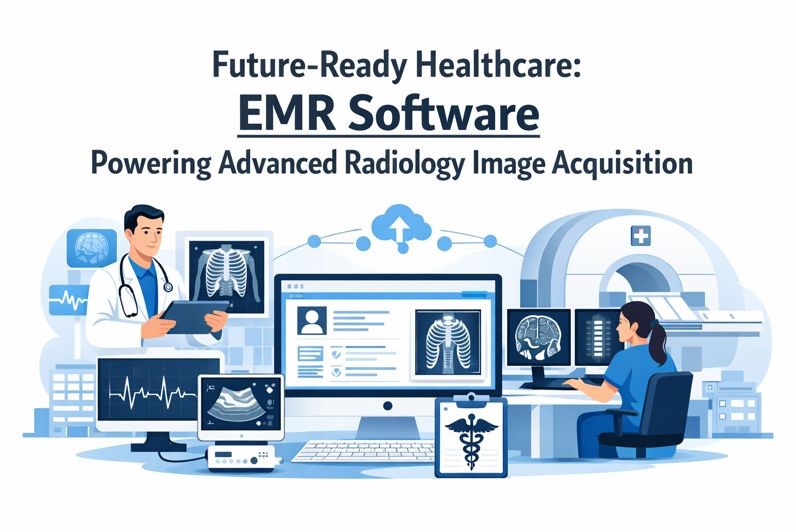
The healthcare sector is experiencing a digital revolution at a rapid pace, with accuracy, speed, and smooth collaboration being some of the key requirements. EMR software is among the most influential inventions and has developed way beyond simple record keeping. Electronic Medical Records Software is an important tool in driving superior radiology and image acquisition, storage, and analysis to make healthcare efficient, connected, and future-ready today.
Radiology departments have been producing hard to keep data of imaging data on a daily basis in the form of X-rays, CT scans, MRIs and ultrasounds. The information is vital in ensuring that the diagnosis is done in time and the patient is taken care of effectively. The modern EMR systems can be considered a game-changer in this context because they allow healthcare providers to directly incorporate imaging workflows into the patient records.
Understanding EMR Software in Modern Healthcare
It is also necessary to define what EMR software is before discussing its use in radiology. EMR software is a computerized tool that contains a medical record of patients, such as clinical notes, diagnoses, treatment plans, laboratory data, and images. Compared to paper records, EMR software enables real-time access to correct and current patient records.
This centralized digital platform will make physicians, radiologists, technicians, and other health care professionals to operate on the same real time data (EMR system hospital setting). This coordination approach goes a long way in enhancing interdepartmental coordination.
With the ongoing development of the software in the healthcare field, the EMR systems are getting smarter, interoperable, and image-centric to cater to the advanced radiology processes with accuracy.
Read: How to Stop USB Devices from Spreading Viruses on your Computer
The Growing Importance of Radiology Image Acquisition
Radiology is the very heart of modern diagnostics. Imaging technologies aid the medical community to diagnose diseases in their early stages, execute treatment, and oversee progress of the patient. Nonetheless, the classical imaging workflows are usually characterized by the following challenges:
- Delayed image access
- Inter-departmental data silos.
- Manual errors in reporting
- Lack of cooperation between experts.
The latest radiology image capture needs efficient communication between imaging devices and EMR systems. The integration makes images capture, storage, sharing and reviewing effective, without affecting accuracy or patient safety.
How EMR Systems Power Advanced Radiology Workflows
The current EMR software products are created to serve radiology departments with more favorable features other than just simple image storage.
1. Seamless Integration with Imaging Modalities
The EMR systems are advanced, and they assist with high-resolution imaging and organized radiology reports. EMR software helps a clinician to have a more comprehensive picture of the patient by combining images with clinical notes and lab data.
This is a holistic access, which enhances diagnostic accuracy, minimizing the redundancies of tests, and evidence-based clinical decisions, which are the objectives of future-ready healthcare.
EMR Software and Workflow Efficiency in Radiology
Reducing Turnaround Time
Radiology is time sensitive. Patient outcomes can be affected by delays in the accessing of images or reporting. Best EMR software solutions simplify the process through the automation of routing of images, generation of reports, and notification.
Radiologists have the ability to access, review images in less time, complete reports on time and share results immediately with referring physicians.
Eliminating Manual Errors
Errors are likely to occur as a result of manual data entries and paper based processes. EMRs reduce such risks by automating the capture process of data and maintaining uniformity in patient records.
This automation improves patient safety and aids in the adherence to healthcare regulations- a crucial parameter in the healthcare industry in the changing healthcare industry.
Role of EMR Software in Collaborative Care
Radiology is not an autonomous field. It is essential to have effective cooperation among radiologists, physicians, surgeons, and specialists.
EMR software enables:
- Real-time image sharing
- Collaborative annotations
- Combinations of clinical deliberation.
Such level of cooperation enhances the coordination of care and secures that the healthcare providers make informed decisions founded on the full patient data.
EMR Software in India: Transforming Radiology Services
The implementation of the EMR Software in India has been rising, faster than ever, with the growing digitization, governmental actions, and the necessity of quality healthcare provision.
Hospitals and diagnostic centers in India are using EMR systems to:
- Manage high patient volumes
- Increase the accuracy of radiology reporting.
- Improve operational performance.
ERM software in India is increasingly becoming critical with the increased investments in digital health as modernization of radiology departments and filling strategic gaps between the urban and rural health sectors.
Data Security and Compliance in Radiology EMR Systems
Images of patients in radiology hold sensitive patient data. Contemporary EMR systems are more focused on the security of data that includes:
- Role-based access control
- Encrypted data storage
- Secure image sharing
- Audit trails
Such security controls can assist healthcare institutions to adhere to the data protection rules and earn patient confidence, which is a crucial necessity in the modern digital healthcare setting.
AI and Advanced Analytics in EMR-Powered Radiology
The intelligent systems are the future of radiology. EMR software systems are becoming more advanced to incorporate artificial intelligence and analytics to improve imaging processes.
Benefits Include:
- Automated image analysis
- Early intervention of abnormalities.
- Radiology decision support.
- Intraprojective forecasts of treatment planning.
Combining AI with EMR systems, healthcare providers may provide patients with quicker, more precise, and more individualized care.
Choosing the Best EMR Software for Radiology
When choosing the most appropriate EMR software in the field of radiology, one should carefully consider the features and scalability. Healthcare organizations have to think about:
- Integration abilities in imaging.
- Interaction with the current systems.
- User-friendly interfaces
- Data security standards
- Personalisation and customisation.
Emerging and established EMR Software vendors are targeting flexible, cloud-based EMR solutions that can adapt to the requirements of radiology and the healthcare ecosystem in general.
The Impact on Healthcare Providers
To healthcare providers, radiology systems that are supported by EMR save on the administrative workload and enhance clinical efficiency. Doctors can also have more rapid access to imaging findings, which can be diagnosed and treated in time.
Radiologists enjoy structured workflow, improved reporting features, and facilitated teamwork- they are able to concentrate on quality clinical work rather than on administrative duties.
EMR Software as a Catalyst for Healthcare Industry Growth
This is because the integration of EMR systems and the modern radiology imaging is revolutionizing the healthcare industry. This synergy increases the diagnostic abilities, minimizes the operating expenses, and improves the patient experience.
Since the shift towards value-based care in healthcare is a persistent trend, EMR software can be considered an innovation basis that facilitates data-driven care and long-term sustainability.
Future Trends in EMR and Radiology Integration
The future-ready EMR systems will keep on changing to include features like:
- Cloud-based imaging access
- Radiology reports using mobiles.
- State-of-the-art AI-based diagnostics.
- Increased cross-network interoperability.
These developments will make healthcare software even more influential in providing competent, precise, and patient-centered care.
Conclusion
The future of healthcare is intelligent digital systems, in which EMR software is at the heart of the evolution. EMR systems can facilitate smooth assimilation, expedition of diagnosis, collaboration, and patient results by driving sophisticated radiology image acquisition.
Electronic Medical Records Software is transforming the way radiology services are rendered in big hospital chains, diagnostic centers, etc. As more and more EMR software is being adopted in India and elsewhere in the world, the healthcare sector stands at the edge of a more integrated, efficient and technologically impressive future.
Investment in the appropriate EMR software solution will continue to be a process that is important in the face of a healthcare provider in the need to be competitive, compliant, and future-ready.
Author’s Bio:
Hello, I am Krupa Ghevariya, an SEO Executive at Healthray Technologies Pvt. Ltd. At Healthray, we specialize in innovative healthcare software solutions, and Laboratory Information Management System.